

CCC CHOIR REGULATIONS: LATE PASTOR A.A. BADA REAFFIRMS ORGANIST’S LEADERSHIP, WORSHIP ETIQUETTE AND HYMN STANDARDS IN 1988 CIRCULAR
Celestial Prerogative News | Historical Church Document
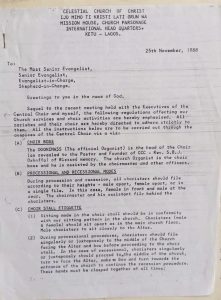
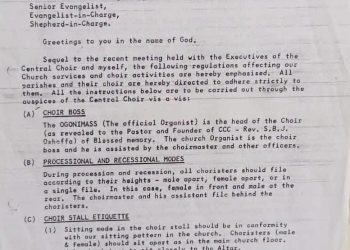
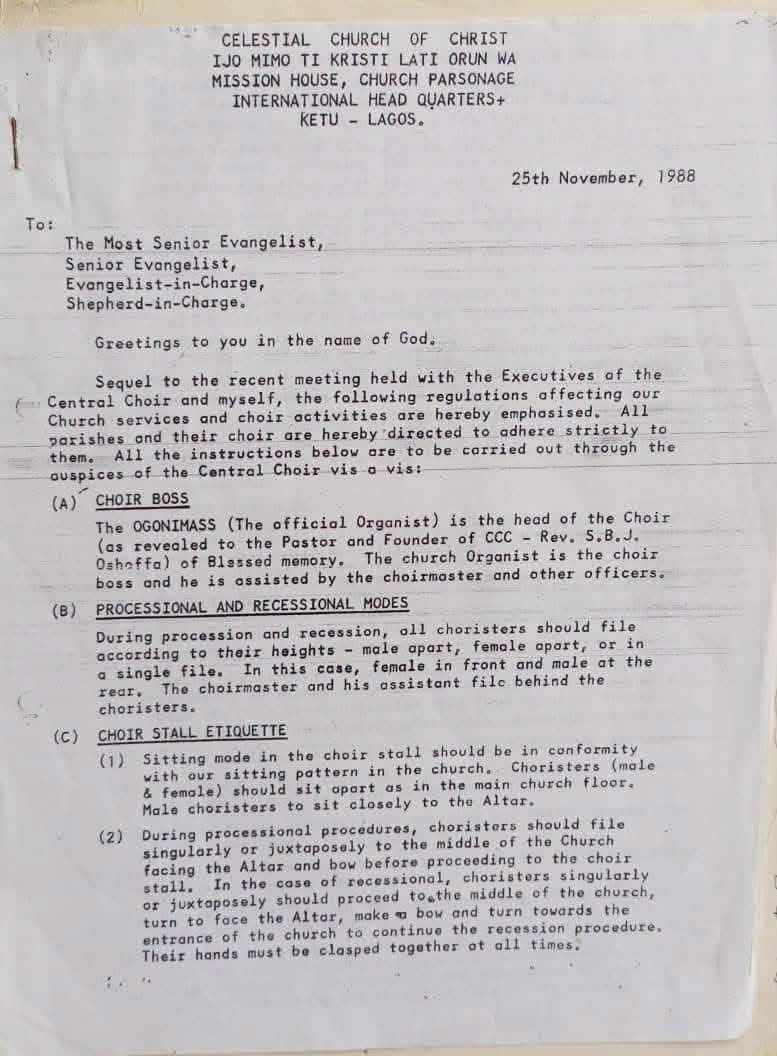
A historical circular dated 25 November 1988, issued by the late Reverend A.A. Bada, then Pastor and Supreme Head of the Celestial Church of Christ Worldwide, outlines a series of regulations governing choir administration, musical performances, hymn rendition, dress codes and conduct during church services.
The circular, issued from the Mission House, Church Parsonage, International Headquarters, Ketu, Lagos, was addressed to Most Senior Evangelists, Senior Evangelists, Evangelists-in-Charge and Shepherds-in-Charge. It followed a meeting between the Pastor and the executives of the Central Choir, during which matters relating to choir activities and church worship were discussed.
The document directed all parishes and their choirs to adhere strictly to the regulations, with implementation to be carried out through the auspices of the Central Choir.
THE ORGANIST AS HEAD OF THE CHOIR
One of the major provisions of the circular concerns the leadership structure of the church choir. According to the document, the Ogonimass, identified as the official organist, is the head of the choir, a position the circular attributes to a revelation received by the Pastor and Founder of the Celestial Church of Christ, Reverend S.B.J. Oshoffa, of blessed memory.
The circular further states that the organist is to be assisted by the choirmaster and other choir officers.
This provision establishes the organist’s leadership position within the choir structure as described in the 1988 directive.
PROCESSIONAL AND RECESSIONAL PROCEDURES
The circular also provides instructions on how choristers should enter and leave the church during processional and recessional activities.
According to the directive, choristers are expected to arrange themselves according to their heights, with male and female members separated or arranged in a single file, with female choristers in front and male choristers at the rear. The choirmaster and assistant are to follow behind the choristers.
During procession, choristers are instructed to proceed in single or paired formation towards the middle of the church, face the Altar and bow before moving to the choir stall.
For the recessional, the choir is expected to return to the middle of the church, face the Altar and bow before turning towards the church entrance to complete the process.
The circular further directs choristers to keep their hands clasped together throughout these procedures.
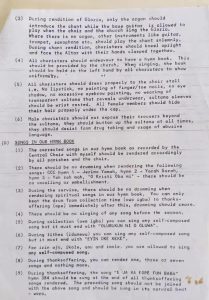
CHOIR STALL ETIQUETTE AND DRESS CODE
The 1988 directive places considerable emphasis on discipline, orderliness and appropriate conduct within the choir stall.
It states that the seating arrangement of choristers should conform to the established seating pattern of the church, with male and female choristers sitting separately and male choristers positioned close to the Altar.
The document also directs choristers to maintain appropriate standards of appearance. Among other instructions, female choristers are cautioned against wearing lipstick, nail polish, eye shadow and excessive eyebrow makeup. The circular also prohibits transparent sultana garments that expose underwear and requires the sleeves of the garment to reach the wrists. Female choristers are further instructed to cover their hair properly beneath their caps.
Male choristers, meanwhile, are directed not to expose their trousers beyond their sultana garments and are instructed to keep their garments buttoned at all times. The circular also cautions male choristers against drug use and abusive language.
In addition, the document directs the church to provide hymn books for choristers and instructs them to hold the books in their left hands while singing, as a means of maintaining uniformity.
REGULATIONS ON HYMNS AND SPIRITUAL SONGS
A substantial portion of the circular addresses the rendition of hymns and spiritual songs during church services.
The document directs all parishes and choirs to use the corrected versions of songs recorded by the Central Choir in collaboration with the Pastor.
It specifically identifies CCC Hymns Nos. 1, 2 and 3 as Jerimoh Yamah, Yarah Sarah and Yah Rah Mah, respectively. It also mentions the song O Kristi Oba Mi, directing that there should be no drumming during the rendition of the specified songs and no vocal embellishments.
The circular further states that drumming should not accompany spiritual songs from the church hymn book during services. According to the directive, drumming is permitted from the collection period, known as Owo Igba, through the thanksgiving offering, known as Ope. Once that period concludes, the drumming is to cease.
The document also prohibits singing before the sermon and instructs choristers not to call out song lyrics while singing.
For collection, the circular permits self-composed songs, provided they end with the words “Olubukun Olowa.” For tithes, known as Idamewa, self-composed songs are permitted but must end with “Eyin Oke Ke.”
For Irin Ajo, Ikole, Anu and Imole, the circular allows the rendition of self-composed songs.
THANKSGIVING SONGS AND MUSICAL ACCOMPANIMENT
The circular specifies that one, three or seven songs may be rendered during the thanksgiving offering, with no additional songs permitted beyond those numbers.
It also directs that CCC Hymn No. 384, “E Ja Ka Fope Fun Baba,” must be sung at the conclusion of all thanksgiving songs. The preceding song must not be joined to it, and the hymn must be rendered in its natural beat.
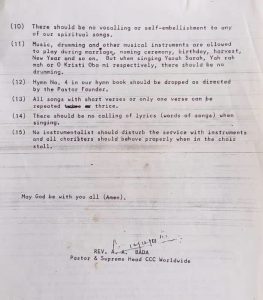
The document further prohibits vocal embellishments and self-improvisation in the rendition of spiritual songs.
However, musical instruments and drumming are permitted during special occasions, including marriages, naming ceremonies, birthdays, harvest celebrations and New Year services. The circular maintains that the restriction on drumming must still be observed when singing Yarah Sarah, Yah Rah Mah and O Kristi Oba Mi.
Another notable instruction in the document is the directive that Hymn No. 4 in the church hymn book be dropped, as directed by the Pastor and Founder.
The circular also permits songs with short verses or a single verse to be repeated three times.
DISCIPLINE AND ORDER DURING WORSHIP
Beyond musical regulations, the circular stresses the importance of maintaining decorum during church services. It warns instrumentalists against disrupting worship with their instruments and directs all choristers to conduct themselves properly while occupying the choir stall.
The instructions collectively address the choir’s leadership, movement, appearance, musical accompaniment and participation in worship, reflecting the standards set out by the church’s leadership in the 1988 document.
A HISTORICAL DOCUMENT FOR THE CCC CHOIR
Signed by Reverend A.A. Bada as Pastor and Supreme Head of the Celestial Church of Christ Worldwide, the circular of 25 November 1988 remains a historical record of the regulations communicated to parish leaders and choir members at that time.
Its provisions offer insight into the church’s approach to choir administration, hymn rendition, worship etiquette and musical discipline during that period.
As discussions continue within religious communities about church traditions and the preservation of established practices, historical documents such as this circular provide an important basis for examining the instructions issued by previous church administrations.