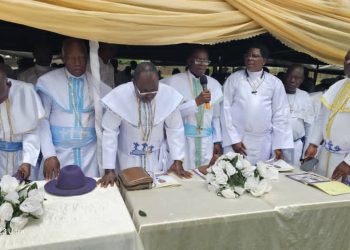



On Sunday, 25th May 2025, the sanctuary of CCC Messiah Cathedral, Povita, Badagry Lagos, Nigeria witnessed a moment of rare spiritual clarity. Most Senior Evangelist Solomon Oshoffa, delivered a sermon that cut through layers of misinterpretation to re-anchor the Church’s doctrine on holiness and humility. His message, while gentle in tone, was profound in impact—reminding the congregation of the simplicity and sanctity of the Gospel originally entrusted to the Church.
At the heart of his sermon was a pivotal clarification that addressed a long-standing theological drift: the idea that the Pastor Founder, Rev Samuel Bilewu Joseph Oshoffa should be regarded as an angelic being. In what many would describe as a necessary doctrinal correction, Evangelist Solomon Oshoffa reaffirmed what the Pastor Founder himself stated decades ago.
“The person that met God in the wilderness, who received the calling of Luli, said he is just a human being and nobody before God,” Evangelist Solomon Oshoffa declared to the congregation.
This single line held deep implications. It was not merely a denial of exaggerated veneration—it was a call back to humility, to seeing the Pastor Founder as a vessel through whom God worked, not a divine figure to be worshipped. This statement is timely and important, especially in an age where spiritual leadership can be distorted into personality cults.
But Evangelist Solomon Oshoffa didn’t stop there.
In what he titled a reflection on the “Negative Action of Sins,” he charged Celestians to actively distance themselves from all appearances and attachments to sin. His teaching was firm yet pastoral, anchoring holiness not in ritual performance but in a lifestyle of purity, repentance, and devotion to God.
The sermon, simple in delivery yet profound in depth, served both as a response to rising theological controversy and as a reminder of the Church’s original calling: Luli—peace, purity, and the power of God manifesting in truth.
At a time when many voices are pulling the Church in different directions, Solomon Oshoffa’s message stands as a clear and courageous appeal to return to sound doctrine, to honour the Pastor Founder rightly—as God’s servant, not God himself—and to take seriously the call to personal and communal holiness.