

The history of church music dates back centuries, with the Western world playing a significant role in the development of sacred music through the contributions of renowned composers whose works helped shape the musical traditions of the Christian faith. Historical figures such as Johann Sebastian Bach, Wolfgang Amadeus Mozart, Ludwig van Beethoven, George Frideric Handel etc made remarkable contributions to the development of classical and sacred music, establishing musical structures, compositions and arrangements that continue to influence church music across the world.
Beyond the Western musical tradition, African church music has also developed a distinctive identity, particularly over the past century. Its evolution reflects the relationship between Christianity, African cultural expressions, indigenous musical instruments, language, rhythm and spirituality. Consequently, African church music has attracted scholarly attention, particularly among ethnomusicologists who study the relationship between music, culture, religion and society.
In his academic contributions to African music studies, Professor Femi Adedeji has emphasised the importance of understanding the historical roots, cultural identity and religious context of African church music when presenting or analysing its musical expressions. Similarly, Professor Abiodun, in his scholarly contributions to the study of Nigerian church music, has drawn attention to the changing character of Christian musical expressions in Nigeria, particularly the influence of secular musical traditions on contemporary church performances. These academic perspectives raise an important question about the musical identity of Celestial Church of Christ: Are we consciously preserving the spiritual and musical heritage handed down to the church, or are we gradually allowing contemporary secular musical influences to redefine it?
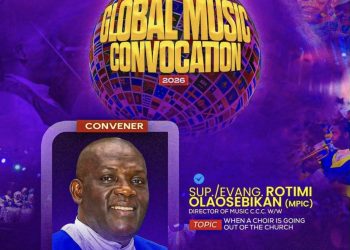
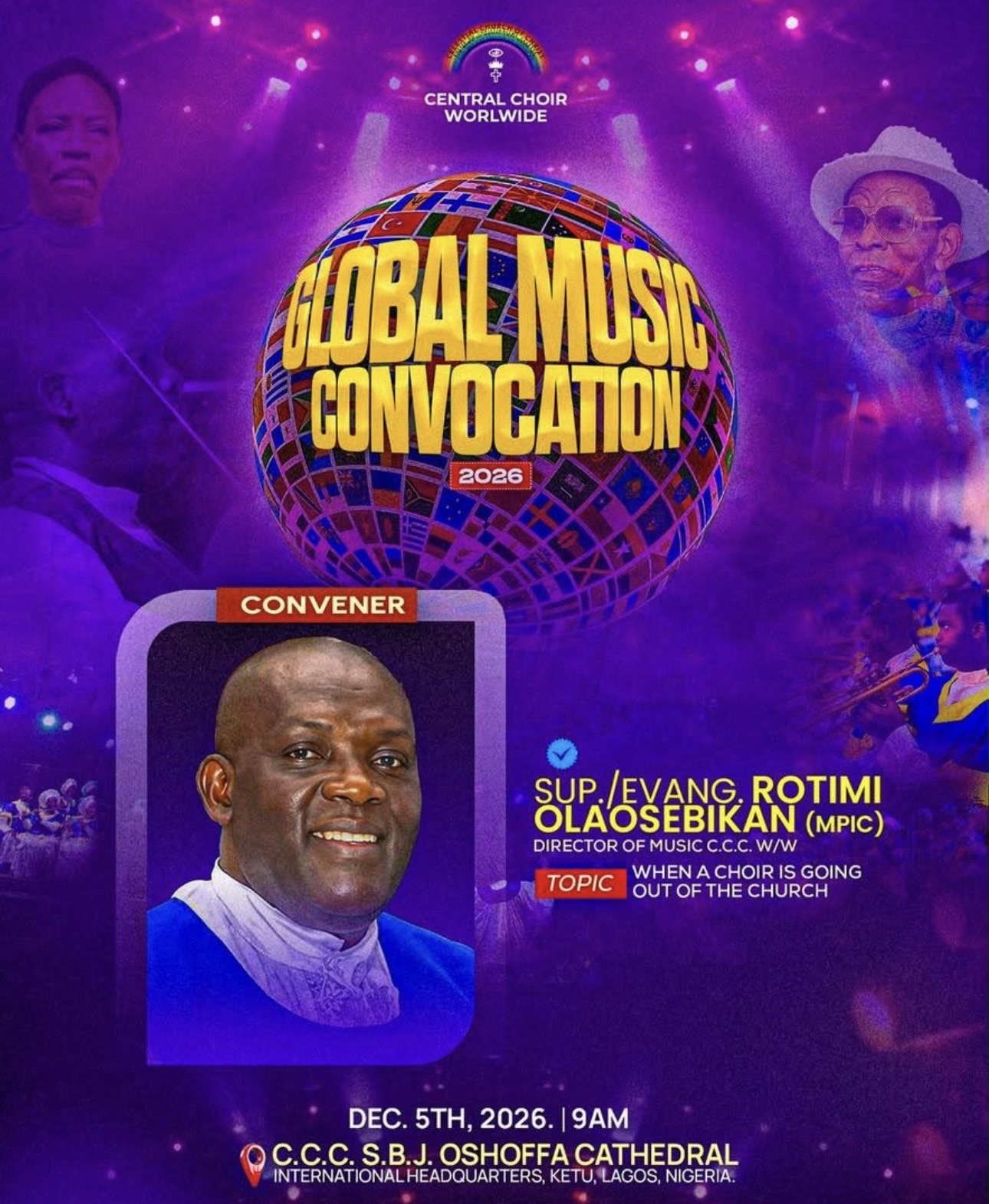
This question becomes particularly relevant as Central Choir of our church prepares to organise its International Conference/Seminar on Saturday, 5th December 2026 at the Church’s National Headquarters, Ketu, Lagos State, under the leadership of the Central Choir Music Director, Superior Evangelist Dr Rotimi Olaosebikan. While the proposed gathering presents an important opportunity to strengthen the musical department of the church, there is a need for the organisers to look beyond the conventional discussions of music and evangelism and give adequate attention to the fundamental challenges confronting Celestial Church of Christ music.
The conference should not become another religious gathering where invited speakers discuss the importance of music in evangelism. Rather, it should provide an intellectual and professional platform for examining the musical challenges that have continued to affect the identity, structure and performance of hymns in Celestial Church of Christ.
It is a well-established account within the history and tradition of Celestial Church of Christ that its hymns were received through divine inspiration and spiritual manifestations. The Pastor Founder, Saint SBJ Oshoffa, did not sit down as a conventional music composer to write the collection of hymns used by the church. Rather, the hymns were received through spiritual revelations and trance experiences, with individuals under spiritual manifestations delivering songs that subsequently became part of the church’s musical heritage.
This spiritual foundation makes Celestial Church of Christ music distinctive among Christian denominations. Its hymns are not simply products of conventional musical composition; they are deeply connected to the spiritual experiences and historical identity of the church. However, the circumstances surrounding the emergence of these hymns also presented challenges, particularly in their musical arrangements, harmonisation, modulation and standardised performance. At the early stages of the church, achieving consistent musical arrangements was not an easy task, considering that the hymns did not originate from conventional music composition processes.
This explains why harmonisation has remained an important subject in the development of Celestial Church music. The late former Music Director of the church, Superior Evangelist Wole Adetiran made considerable efforts towards addressing this challenge, particularly through initiatives aimed at improving hymn arrangements and harmonisation. His efforts, including the involvement of the National Hymns Council, demonstrated the importance of establishing a more consistent musical structure for the church’s hymns.
His contributions should remind the present leadership that the challenges surrounding Celestial Church of Christ music are not new. They are longstanding issues that require deliberate professional attention, institutional commitment and continuity. Therefore, the forthcoming conference should create room for a comprehensive discussion on how the church can achieve a universally acceptable system of hymn harmonisation, arrangement and modulation without compromising the original spiritual character of its hymns.
Another critical issue that deserves serious attention is the growing influence of secular musical styles on performances in Celestial Church of Christ. Historically, the church developed distinctive musical expressions, including the traditional Chuchu and Slow Alive styles, which became recognisable elements of its musical identity.
These styles were associated with particular rhythms, tempos and patterns of musical expression that distinguished Celestial Church of Christ music from other contemporary Christian musical traditions. However, over the past 15 to 20 years, there has been a noticeable transformation in the musical approach adopted by some choirs and musical groups within the church.
The introduction of increasingly fast-paced rhythms, contemporary instrumental arrangements and performances influenced by secular music has raised questions about the direction in which Celestial Church of Christ music is heading. In some instances, performances have adopted very high tempos, reportedly ranging between 120 and 150 beats per tempo, accompanied by lyrical expressions and musical arrangements whose suitability for the spiritual environment of the church deserves careful examination.
The concern is not necessarily that every contemporary musical expression is inappropriate for worship. Music, like every other art form, evolves with time. However, such evolution must not come at the expense of the spiritual identity, doctrinal values and established musical traditions of the church. There must be a clear understanding of the distinction between musical innovation and the gradual abandonment of an institution’s musical heritage.
The Central Choir conference should therefore establish a serious discussion around the question of what constitutes acceptable musical performance within Celestial Church of Christ. What should be the acceptable tempo for different categories of church music? What standards should guide instrumental arrangements? How should choir directors distinguish between sacred musical expressions and secular entertainment influences? These are technical and scholarly questions that deserve answers from people with the requisite academic and professional understanding of music.
Beyond secular influence, another major challenge confronting the musical department of the church is the absence of a universally agreed standard for the performance of hymns across its parishes. Celestial Church of Christ is one spiritual institution with a common identity, yet musical interpretations and arrangements sometimes differ considerably from one parish to another. A hymn that is performed in one parish may sound entirely different when rendered in another parish, not necessarily because of intentional musical innovation but because of the absence of a universally accepted performance standard. This situation raises an important question: Should a church with a common spiritual heritage continue to operate without a clearly established standard for the musical interpretation and performance of its hymns?
The convention should consider the introduction of a uniform hymn performance framework that can be adopted across the church’s parishes worldwide. There should be an agreed arrangement for the church’s hymns, particularly those commonly used during regular worship services. Such an initiative would help promote consistency, preserve the original character of the hymns and strengthen the musical identity of the church. This does not mean that every musical expression must be deprived of creativity. Rather, the church should establish an acceptable foundation upon which creativity can operate without undermining its established musical heritage.
A centralised and professionally coordinated hymn arrangement system would also assist choir directors, organists and instrumentalists in different parishes to work with a common musical reference. Perhaps one of the most important considerations for the organisers of the forthcoming conference is the selection of resource persons. There is a fundamental difference between someone who loves music and someone who has studied music professionally. An individual may possess a passion for singing, enjoy playing musical instruments and demonstrate considerable enthusiasm for church music. However, such enthusiasm does not automatically translate into the academic and technical knowledge required to address complex musical challenges.
This is why the organisers should prioritise the involvement of ethnomusicologists and professionally trained musicologists who are members of Celestial Church of Christ and who understand the historical, spiritual and technical foundations of its music. Their participation would provide an opportunity to examine the church’s musical heritage from both academic and practical perspectives. The objective should be to bring together people who understand musical composition, harmonisation, modulation, rhythm, instrumentation, musical arrangements and the relationship between African religious identity and contemporary musical influences.
Evangelists and other spiritual leaders undoubtedly have important contributions to make, particularly regarding the spiritual significance of music in worship. However, their spiritual knowledge and love for music should complement, rather than replace, the technical contributions of music professionals. The convention must recognise that discussing the spiritual importance of music is different from providing professional solutions to the technical challenges of music. The church needs people who do not merely appreciate its music but also understand its musical structure, study its historical development and possess the professional competence to address its challenges.
Furthermore, the resource persons should ideally be Celestial Church of Christ members who understand the church’s liturgy, hymn traditions and the peculiar challenges associated with its musical practices. This combination of professional expertise and institutional understanding would make the conference more meaningful.
Another development that deserves attention is the need for improved administrative coordination between the Central Choir leadership, the church’s music department and the relevant authorities. Earlier this year, the introduction and presentation of a four-part harmonisation of some church hymns reportedly took place without the direct involvement of the Central Choir Music Director. This development raises legitimate questions about the administrative processes guiding decisions within the musical department.
If the church has appointed a Music Director to oversee and coordinate its musical affairs, why should significant musical initiatives be introduced without the involvement of the office responsible for that assignment?
Can Senate pass an important resolution without the involvement of its presiding authority, particularly where the matter directly concerns the responsibilities of that office? The comparison may not be identical in every administrative detail, but the underlying principle remains important: institutional responsibilities must be respected. An appointment should not be ceremonial. It comes with responsibilities, authority and an expectation that the appointed individual will be allowed to discharge the assigned duties diligently.
The church must discourage administrative practices that create unnecessary divisions between appointed officers and those responsible for implementing decisions. The Central Choir Music Director should be at the centre of decisions concerning hymn arrangements, harmonisation, musical standards and the overall direction of the church’s musical department. This is not an argument for absolute authority without consultation. Rather, it is a call for proper institutional coordination, mutual respect and professional accountability. The wider administrative challenges within the church should also remind the authorities that departmental leadership cannot function effectively when appointed officers are bypassed in matters directly connected to their responsibilities.
As the Central Choir prepares for its 5th December 2026 convention, expectations should go beyond the gathering of choir members, invited guests and religious personalities. The convention should be an opportunity to establish a clear direction for the future of Celestial Church of Christ music. Its discussions should produce practical recommendations on hymn harmonisation, standardised musical arrangements, the influence of secular music, acceptable lyrical expressions, choir conduct and the preservation of the church’s traditional musical identity. There should also be a deliberate effort to establish a uniform hymn performance structure that can be adopted by parishes across the worldwide church.
Most importantly, the conference should provide a platform for qualified ethnomusicologists and musicologists within the Celestial fold to contribute their professional knowledge towards finding lasting solutions. The Central Choir should also strengthen its relationship with the various parish choirs and establish a system through which musical standards and recommendations can be communicated and implemented consistently.
Celestial Church of Christ possesses a unique musical heritage rooted in its spiritual history and divine foundation. Such a heritage deserves deliberate preservation, professional development and institutional protection. The forthcoming convention organized by the Central Choir is therefore an important opportunity that must not be wasted on discussions that fail to confront the actual challenges facing the church’s music. The organisers, under the leadership of Superior Evangelist Dr Rotimi Olaosebikan must understand that the future of Celestial Church of Christ music requires more than enthusiasm, singing competitions and discussions about evangelism. It requires scholarship, professional engagement, administrative cooperation and a genuine commitment to preserving the identity of the church’s hymns.
The church must be willing to confront the growing influence of secular musical expressions, address the absence of uniformity in hymn performance and establish a professional framework for harmonisation and musical arrangements. The question is no longer whether Celestial Church of Christ music should evolve. The real question is whether that evolution will be guided by a proper understanding of its spiritual foundation and musical identity.
The Central Choir conference must be a platform for finding solutions, not merely discussing the beauty of music. The church needs musicologists who understand the science of music, ethnomusicologists who understand its cultural and religious identity, and spiritual leaders who can ensure that every musical development remains consistent with the spiritual heritage of Celestial Church of Christ. After all, there is a clear difference between loving music and studying music. At this critical moment in the history of Celestial Church of Christ music, the church needs both, but it must recognise when professional knowledge is required to solve professional problems.
Celestial Prerogative News