


God’s mandate to humanity is clear: to spread the Gospel of His Kingdom in truth, order, and obedience. In fulfilling this divine assignment, God handpicked the Pastor Founder, Rev. S.B.J. Oshoffa to establish a Church commissioned to cleanse the world through holiness, discipline, and strict adherence to divine instruction. Unfortunately, over time, the boat has continued to encounter turbulent waters largely driven by administrative struggles, personal ambitions, and the elevation of rank and position above spiritual obedience.
Within Celestial Church of Christ, administrative authority has increasingly become a battleground where opinions compete for dominance, rather than a platform for collective submission to God’s instructions. This reality has manifested most visibly in various dioceses, including one of the Church’s most historically influential territories the UNITED KINGDOM DIOCESE.
The United Kingdom Diocese remains one of the strongest and most symbolic dioceses in the history of the Church. Established during the lifetime of the Pastor Founder, it once exemplified the true spirit, discipline, and doctrinal purity of the Church. Under the leadership of Late Rev. P.H. Ajose, discipline was non-negotiable, Church doctrines were strictly upheld, and obedience to constituted authority was the guiding principle of leadership.
However, as internal crises deepened within the Church’s central administration in Nigeria, the ripple effects gradually spread abroad. In the UK Diocese, energy that should have been devoted to worship, evangelism, and spiritual growth became increasingly redirected toward leadership control, power struggles, and factional alignments, sometimes resulting in the qualified being side-lined while the unqualified assumed oversight roles. In line with Church tradition, major administrative decisions are often pronounced by the Pastor after the annual Convocation. On 26th December 2025, the Pastor, Rev. EMF Oshoffa formally announced the completion of tenure of the Head of the United Kingdom Diocese, Most Superior Evangelist (MSE) Amos Fastuin.
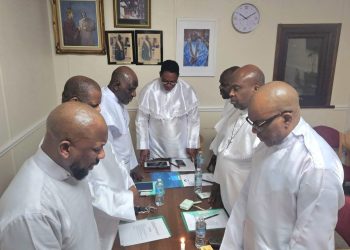
Reactions to the announcement were mixed. To some members, the decision was long overdue, citing an administration marked by controversies and unresolved tensions. To others, MSE Fastuin was perceived as a leader who did his human best under extremely difficult circumstances. The diversity of opinions reflects the depth of division that had already taken root within the Diocese. Simultaneously, the Pastor approved the appointment of a six-month Management Committee, headed by Venerable Senior Evangelist Ayo Osho with the mandate to oversee the Diocese and recommend a substantive Head of Diocese. Long before the removal of MSE Amos Fastuin, the Diocese had already fractured into two major blocs. One faction aligned with the existing UK Diocese leadership, while another emerged under the UK/NI (United Kingdom/Northern Ireland) Diocese, led by VSE Alagbado, following deep disagreements over leadership style and administrative direction.
As tensions escalated, shepherds and workers increasingly aligned themselves based on personal convictions, loyalties, and faith in competing leadership structures. This division intensified the resistance and counter-reactions surrounding the eventual removal of MSE Fatusin, compelling the Pastor to weigh numerous complaints, reports, and recommendations before arriving at a final decision. One of the emerging concerns surrounding the newly constituted Management Committee is BALANCE. Critics argue that the composition of the committee does not adequately reflect equilibrium between the UK Diocese and the UK/NI Diocese, with one faction perceived to hold a numerical advantage raising questions about fairness, inclusiveness, and trust.
History offers a sobering lesson. During the eras of Late Rev. P.H. Ajose and Late Rev. Pastor A.A. Bada, prominent leaders such as Senior Evangelist Salu (Edward Street Parish, London), Venerable Evangelist Magbagbe (North London Parish), AVSE J Sebioba (Elephant & Castle Parish), and Senior Evangelist Ayodado (East London Parish) were unable to agree on a consensus candidate for over three months. Eventually, Late Rev. Pastor A.A. Bada appointed MSE Olarinde, a man who never contested for the position demonstrating that divine choice often overrides human ambition.
The task before the Management Committee is enormous. Beyond recommending a new Head of Diocese, it must find a way to reunite fragmented factions under a single administrative and spiritual umbrella. This will be no easy feat, especially in an environment where competing interests, historical grievances, and strategic positioning threaten genuine reconciliation.
Another unresolved question is whether the next Head of the UK Diocese will be selected among shepherds resident in the United Kingdom or appointed from outside the country. While external appointments may appear neutral, history also records painful experiences such as the case of Late VSE Akaji, whose leadership tenure was disrupted by immigration complications, eventually leading to deportation following reports to authorities.
This reality underscores the sensitivity and risk associated with appointing leaders without secure legal footing within the host country.
The Way Forward: RECONCILIATION BEFORE APPOINTMENT
The most urgent responsibility of the Management Committee is not the selection of a new Head of Diocese, but the initiation of a genuine reconciliation process. Many observers believe this process must begin within the first three weeks of the committee’s assumption of duty. Without reconciliation, any appointment, no matter how qualified risks rejection, resistance, or eventual failure. Unity, humility, and submission to divine order must precede administrative decisions if lasting peace is to be restored.
As events continue to unfold, the faithful watch with cautious hope, praying that wisdom, fairness, and God’s will not personal interests will ultimately prevail in shaping the future of the United Kingdom Diocese.